Drift in drone spraying: does it reach the neighbour's field?
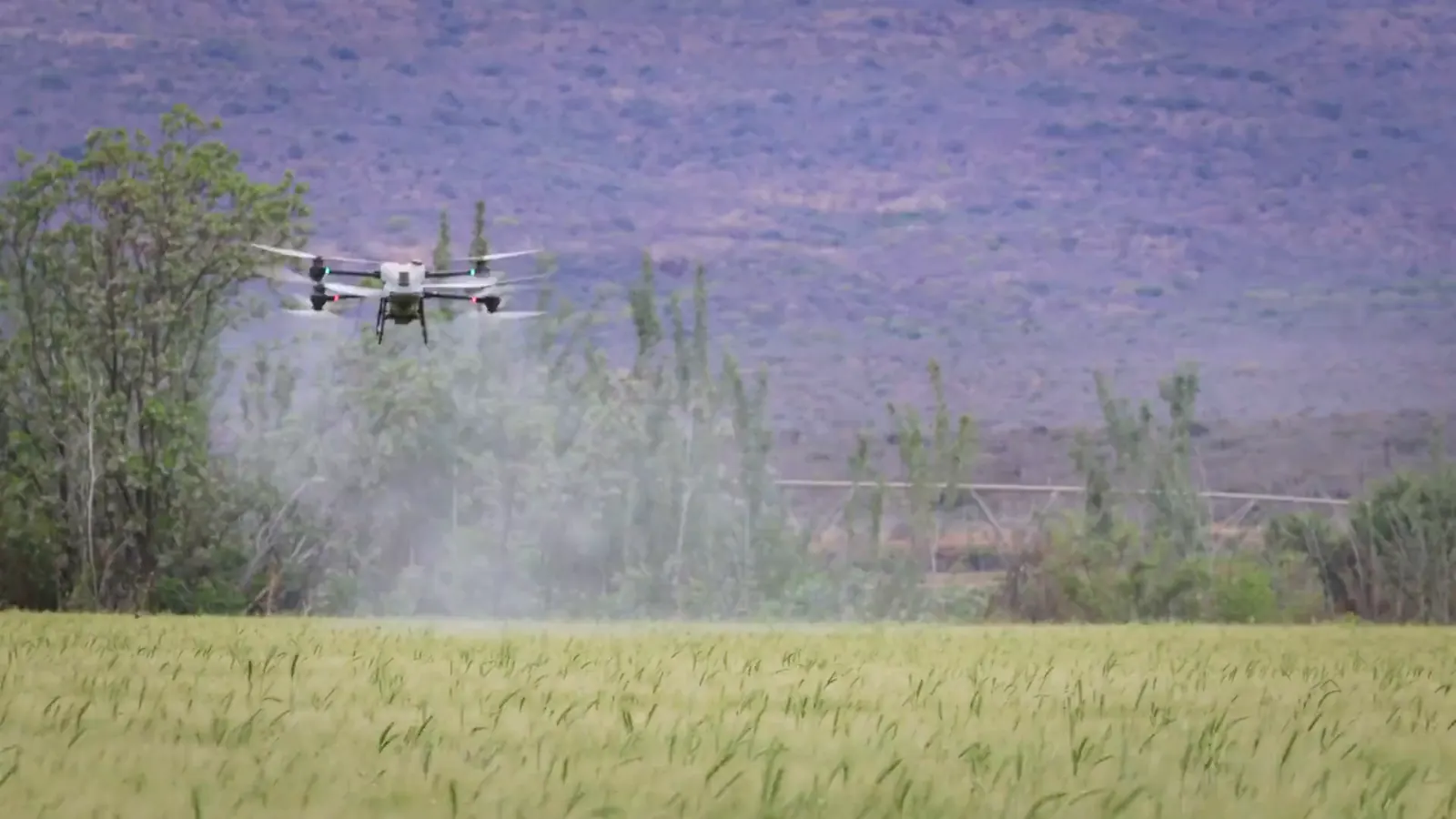
Drift in drone spraying depends mostly on wind, flight height and droplet size. We spray in winds up to 3 to 5 m/s and fly about 3 metres above the crop. When the wind picks up, we pause and carry on as soon as it drops. We apply herbicide by drone only when the neighbouring fields carry the same crop, which that herbicide does not harm.
By Nikola Mojsa, MSc in Agricultural Engineering
What affects drift in drone spraying
In a field trial with a drone fitted with centrifugal nozzles, like those on the DJI Agras T70P, drift increased with wind speed and decreased with droplet size (Wang et al., Science of the Total Environment, 2020).
In a trial at China Agricultural University, droplet size, flight speed and flight height were varied, and of the three settings height mattered most (Li et al., Pest Management Science, 2026).
The fourth factor is heat: we don't spray in the hottest part of the day, because the product doesn't work then. For tractor spraying, agroklub.rs, citing the German magazine Agrarheute, gives a temperature below 25 °C and air humidity above 30% (agroklub.rs, 2024, in Serbian).
Some herbicides drift even after the droplet has landed. The same source names the active ingredients pendimethalin, clomazone and prosulfocarb, which evaporate quickly, so the wind carries them off soil particles too.
Up to what wind speed we spray by drone
The upper limit for good work is a wind of 3 to 5 m/s. The forecast on your phone usually shows wind in km/h, which works out at 11 to 18 km/h. In the field you can recognise it by leaves and thin twigs in constant motion.
For products that drift easily and can damage a neighbouring crop, the drone manufacturer recommends wind below 3 m/s. Above 6 m/s, according to the manual, the drone does not spray at all (DJI, Agras T70P user manual, p. 28).
| Wind | In the forecast | What you see in the field | Drone spraying |
|---|---|---|---|
| up to 1.5 m/s | up to 5 km/h | Smoke rises almost vertically | We spray |
| 1.6 to 3.3 m/s | 6 to 11 km/h | Wind felt on the face, leaves rustle | We spray |
| 3.4 to 5.5 m/s | 12 to 19 km/h | Leaves and thin twigs in constant motion | Upper limit (up to 5 m/s); when the wind picks up, we stop |
| 5.5 to 7.9 m/s | 20 to 28 km/h | Wind raises dust and moves small branches | We don't spray |
| 8 m/s and above | 29 km/h and above | Small trees sway | We don't spray |
Wind descriptions from the Beaufort scale (Wikipedia, in Serbian); drone limits: DJI and AeroVita Agro.
Droplet size and flight height
We fly about 3 metres above the crop. The drone holds that height by itself: it tracks the ground and the top of the crop with radar and cameras, so the gap is the same over wheat as over 2-metre maize (DJI, user manual, p. 13). In the China Agricultural University trial, height had the biggest effect on drift, and the authors recommend flying lower than 3 m as the first measure against it.
The DJI Agras T70P sprays droplets of 50 to 500 microns, and the droplet size is adjustable. In the same trial, coarser droplets cut airborne drift more than slower flight did, while the amount of product on the treated area did not change significantly with either droplet size or flight speed. So a coarser droplet protects the neighbour's field and takes nothing away from yours.
Field edges, neighbours, bees and water
We apply herbicide by drone only when both conditions are met: the crop has grown too tall for a tractor or the field is impassable after heavy rain, and the neighbouring fields carry a crop that the herbicide does not harm. If sunflower, vegetables or an orchard grow next to your maize, we don't apply herbicide by drone. Which maize treatments we do by drone and which stay with the tractor is set out on the drone spraying maize page.
Before every insecticide spray we notify beekeepers nearby so they can close their hives in time. If you know whose hives are near your field, tell us when we agree the job.
The field boundary is drawn into the flight plan, and the drone sprays only inside it. Any part that must not be sprayed, such as a strip along a canal, is marked as a no-spray zone: the drone flies over it but does not spray (DJI, user manual, pp. 48 and 50). The width of the buffer strip next to water is set by the product label.
How the drone covers the crop
The downdraught from the rotors drives fine droplets into the canopy, so the product reaches the lower leaves. That is why the drone works well against small pests such as pollen beetle in oilseed rape and mites in soybean, using 15 to 20 litres of water per hectare on field crops.
New clients get the first hectare free on a first order of at least 10 ha. How a job runs from your call to spraying, and what you prepare, is described on the drone spraying page.
Frequently asked questions
It can, by several times. In the China Agricultural University trial, depending on height, speed and droplet size, the drone drifted 1.5 to 17.9 times more product than a tractor sprayer (Li et al., 2026). A tractor sprayer's booms run no more than 50 cm above the crop (agroklub.rs, in Serbian), while the drone flies at about 3 metres, so the droplet falls for longer. For herbicides at early stages, when the droplet needs to land as close to the weeds as possible, a tractor does the job well. We compare the cost per hectare of both methods on the drone or tractor page.
We don't spray above 5 m/s (18 km/h); at that point the wind starts to raise dust and move small branches in the field. In winds of 6 m/s or more, according to the manufacturer's manual, the drone does not spray at all. For products that drift easily and can damage a neighbouring crop, DJI recommends wind below 3 m/s, that is, below 11 km/h.
In a field trial with a drone fitted with centrifugal nozzles, about ten times less product landed 12 m downwind than on the treated strip itself, and at 50 m almost none of the trials measured anything (Wang et al., 2020). Those figures apply to that trial; on your field they depend on the wind that day and the droplet size.
- First hectare free
- Free travel up to 50 km
Drone spraying price for your field
Tell us the crop, area, field location and what is growing on the neighbouring fields. The neighbours decide whether we can apply a herbicide by drone, and you get the price per hectare straight away.