
Drone or tractor spraying: when each one wins
The drone is the clear choice when the crop is taller than 1.5 m, when the field is under water after rain and when the spray window can't wait: the drone doesn't trample the crop, while a tractor destroys 5 to 6% of the plants for good. The tractor is the better choice when you already own one, the field is fully dry and the crop is low, and for soil-applied herbicides soon after sowing.
A comparison in seven points
Tractor water volumes and waiting days after rain are typical field figures and vary from field to field.
Figures from our own work in Banat; a tractor costs about RSD 2,000 per cadastral jutro. The drone price depends on the area; in both cases you supply the product and the water.
| What we compare | Drone | Tractor |
|---|---|---|
| Tall maize and sunflower | Treats from above at any growth stage. | Can't get in once the crop is taller than about 1.5 m. |
| Field after rain | Never enters the field. The road to the field only needs to dry, and with a paved road it works the same day. | Waits 2 to 5 days for the field to dry. |
| Crop trampling | None. The drone never touches the crop. | Wheels crush 5 to 6% of the crop. |
| Timing | When the crop needs the treatment. | When the field and the crop height allow. |
| Water per hectare | About 15 to 20 litres. | About 150 to 400 litres. |
| Soil compaction | None. The drone never touches the ground. | The heavy machine compacts the soil in its wheel tracks. |
| Area per day | About twice as much as a tractor. With the fields in one place, about 20 ha an hour. | About half as much as the drone. |
Crop trampling: what a tractor pass really costs
Once the rows have closed, a tractor in an established crop tramples 5 to 6% of the crop. Our agronomist sees this regularly in fields across Banat. On 30 ha, that means 1.5 to 1.8 ha of yield never reaches the weighbridge.
The sum for your field is simple: hectares × 5% (or 6%) × expected revenue per hectare = value of the yield destroyed. Take 30 ha: a 5% loss is 1.5 ha. If a hectare brings in €1,000, that single tractor pass cost you €1,500 in lost produce. Put in your own yield and selling price.
The point, by crop value, up to which a tractor pays and beyond which the drone takes over is worked out here: drone or tractor, the per-hectare sums.
Tall maize and sunflower
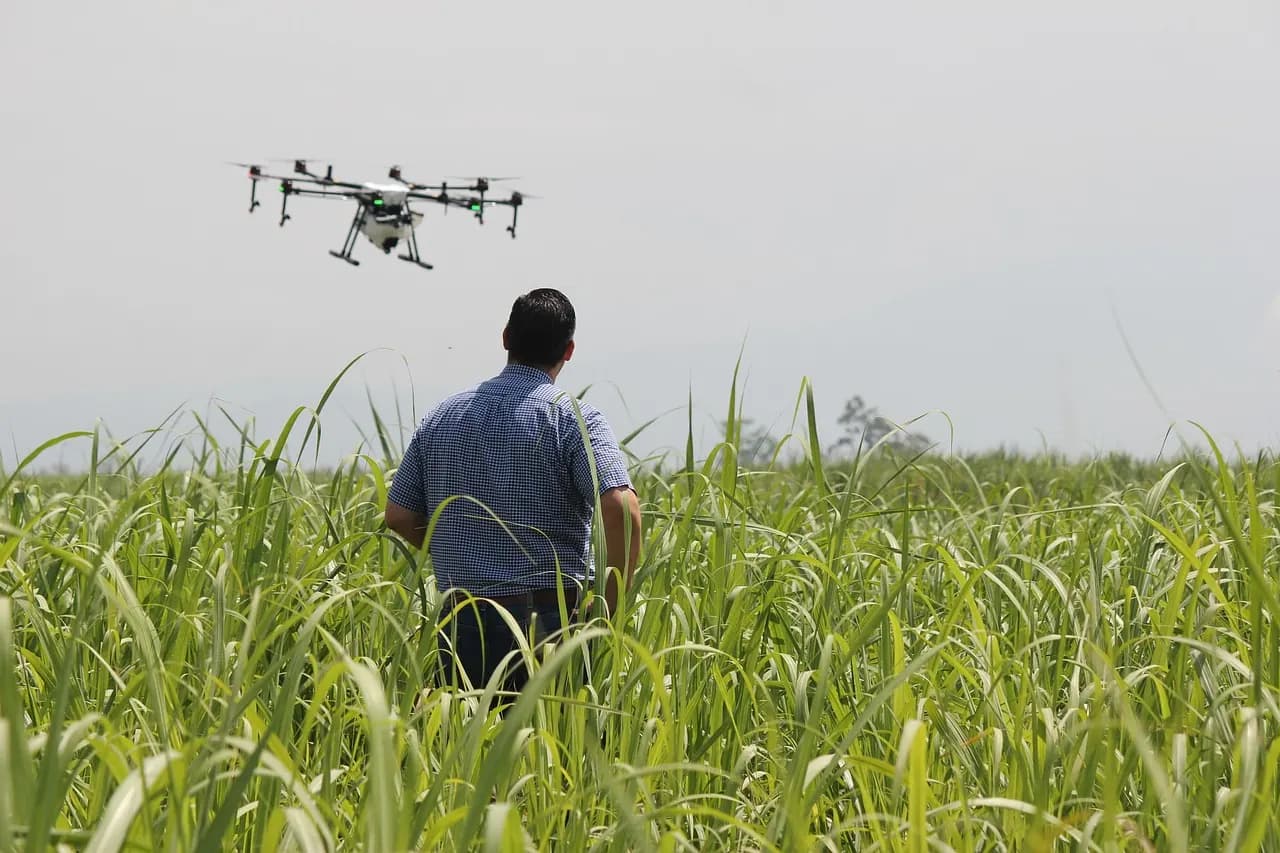
Spraying maize and sunflower by tractor makes sense until they pass 1 to 1.5 m in height. Every treatment after that is a job for the drone. The drone flies 3 metres above the tops of the plants and follows the terrain automatically, working just as well in 1 m maize as in 2.5 m maize, while the rotor downdraft drives the droplets down to the lower layers of the plant.
In maize this means European corn borer control (the second generation flies in late July and August, when the maize is at its tallest), fungicide treatments and foliar feeding. In soybean and sunflower it means desiccation, and in sunflower also the fungicide at flowering. More: drone spraying of maize.
The field after rain
A tractor has to wait 2 to 5 days before it can enter a waterlogged field. The drone only needs the access road to the field to dry. If there is a paved road to the field, we spray the same day, as soon as the rain stops.
This is critical for treatments with tight windows: the insecticide against corn borer must go on before the caterpillars bore into the stem, and the fungicide against fusarium head blight only at the start of flowering. In those cases, 5 days of waiting for the tractor means a missed window and lost yield.
How much water per hectare
For field crops the drone uses only 15 to 20 litres of water per hectare; a tractor uses 150 to 400 litres. On 100 ha that is 1,500 to 2,000 litres of water by drone instead of 15,000 to 40,000 litres. Orchards, vineyards and vegetables need a higher volume and therefore more flights.
The much lower water volume changes only the dilution: the rate of active ingredient per hectare stays exactly as on the label. You choose the product on your agronomist's advice, and our specialist mixes it accurately in the field.
When the tractor is the better choice
- Pre-emergence and early post-emergence herbicides. A soil-applied herbicide has to go onto the soil in a large volume of water, close to the weed seeds, which a tractor sprayer with lowered booms does best. Since the crop hasn't emerged yet, there is no trampling damage. We apply herbicides by drone only when prolonged mud keeps the tractor out and the crop is outgrowing the treatment stage, and only when neighbouring crops are safe from drift. Timings: spraying maize before emergence.
- When you have your own sprayer, the field is dry and the crop is low. Then you only pay for your own time, fuel and machine depreciation.
- When the label strictly prohibits low-volume application. In that case, the label comes first.
Price: drone and tractor per hectare
Contract tractor spraying costs about RSD 2,000 per cadastral jutro on the market (about €30 per hectare), and that is before the yield lost to trampling. In both cases you supply the product and the water.
| Price per hectare | |
|---|---|
| Drone, up to 20 ha | €25 |
| Drone, 20 to 100 ha | €22 |
| Drone, over 100 ha | €20 |
| Contract tractor | about €30 |
| Your own tractor | fuel, time, depreciation |
Travel within 50 km of Opovo is free. Full price list.
Performance in practice and in trials
Field trials confirm that drones perform well. In a 2024 sunflower trial, two fungicide treatments by drone with only 10 litres of water per hectare reached 94% efficacy, while a single treatment at 200 litres per hectare (also applied by drone, standing in for a tractor sprayer) reached only 58%.
The trial does not claim the drone solves everything. It shows that two timely low-volume passes, where a tractor can no longer get in, give far better results than one heavy drenching. The authors also report that ultra-low volume (ULV) application increased fungicide efficacy by 23 to 35%.
Source: Șerban et al. (2026), “Efficacy of Drone-Applied Fungicide Treatments in Control of Sunflower Diseases”, Drones 10(1), 33, doi.org/10.3390/drones10010033. The trial used a DJI Agras T50.
Questions about drone or tractor spraying
Compared with a contract tractor, yes. The drone costs €20–25/ha; a contract tractor about €30/ha. Compared with your own tractor, the drone means paying out cash, but in a tall crop the tractor destroys 5 to 6% of the plants, on top of your fuel, time and machine wear. Check the exact break-even for your field in the per-hectare sums.
Yes. The drone produces fine droplets (50 to 500 microns, manufacturer data), and the strong downdraft from the rotors pushes through the canopy and carries them down to the lower leaves. The rate of active ingredient per hectare always stays the same.
Yes. All we need is a firm or paved road to the edge of the field to take off from. We only stop for heavy rain while spraying or when the wind goes above 3 to 5 m/s.
For soil-applied herbicides before and just after emergence (when the crop and weeds are very small and the field is dry). A tractor is a perfectly sensible choice in early spring, until the plants pass one metre in height.
- No trampling
- After rain
Try it on one hectare
New clients get the first hectare free on a first order of at least 10 ha. That way you can test the coverage, and the difference from a tractor, without risk.