DJI Agras T70P: the drone we spray your fields with
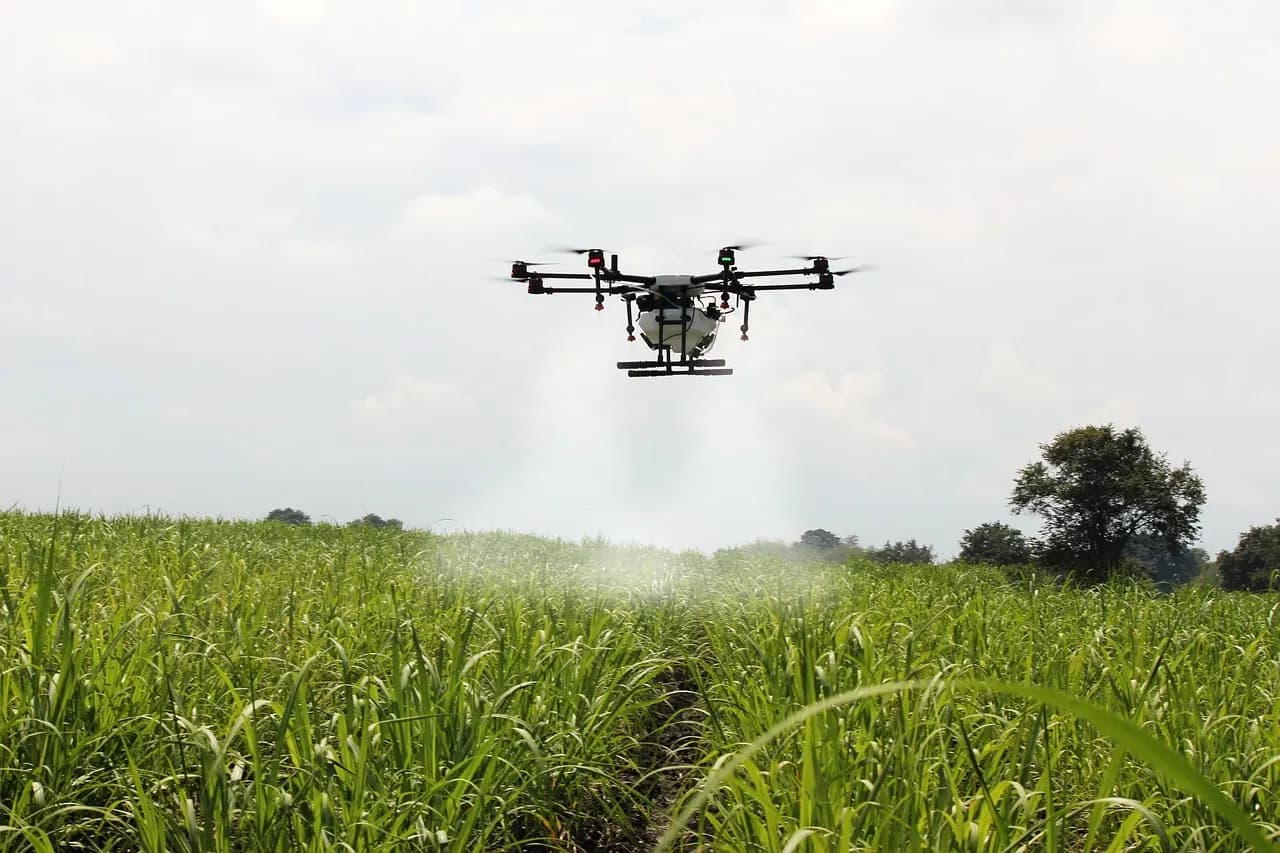
The most advanced technology in the field: it carries 70 litres in one flight, sprays an effective swath of 4 to 11 m, and with a quick module change it spreads dry granules of up to 10 mm precisely.
Key performance in the field
70 L
Tank
Covers 3.5 to 4.7 ha per fill (at a rate of 15 to 20 L/ha).
4–11 m
Spray width
The spacing between passes is set in the software for each plot individually.
50–500
Droplet size in microns
The air stream from the rotors drives droplets deep through the crop.
30 L/min
Flow rate
Delivers up to 20 ha per hour (when plots are close together).
A 70 litre tank
At the standard field-crop rate of 15 to 20 litres of water per hectare, a single fill of the drone covers 3.5 to 4.7 ha. On 40 ha we use 600 to 800 litres of water in 9 to 12 flights, a big logistics saving compared with the 6,000 to 16,000 litres a tractor sprayer needs. The declared payload is 70 kg, and the app suggests a load weight according to conditions, which we follow strictly.
Our tank is refilled through a hose system directly from the trailer. You supply the water at the field, and our agronomist Nikola is responsible for mixing the product properly and precisely before every take-off.
A spray swath of 4 to 11 metres
The manufacturer DJI declares an effective spray swath of 4 to 11 metres, varying with the crop and field conditions. The spacing between passes is entered for each field in the smart flight plan. Obstacles (such as power lines or trees) and exclusion zones are marked in the software in advance, while exceptionally small or irregular plots are flown in an adapted manual mode.
Droplets of 50 to 500 microns
The atomisers break the liquid into droplets of 50 to 500 µm, and the drone flies about 3 metres above the plant tops. The strong downward thrust from the rotors pushes this fine aerosol down, giving excellent coverage even on the lower leaves.
We work only at safe wind speeds, from 3 to 5 m/s, although the manufacturer technically permits work up to 6 m/s. For herbicides and products sensitive to drift, we follow the DJI recommendation and fly only when the wind is below 3 m/s. Whenever the product changes, the system is calibrated with about 2 litres of clean water, so that the dose in the field matches the planned one.
A flow rate of up to 30 litres per minute
The two-pump system delivers a flow of up to 30 L/min using two standard nozzles (with an upgrade option to four nozzles, up to 40 L/min). When plots are close together, this flow lets us treat about 20 hectares in an hour, so in one day we do twice the output of a conventional tractor.
A smart function: when the tank runs empty in the middle of a field, the drone records the point on the map, switches the pumps off, returns to refill and then resumes spraying exactly where it stopped.
Spreading granules of 0.5 to 10 mm
With the spray system removed and a special module fitted, the drone becomes a precise spreader of dry granules from 0.5 to 10 mm. That lets us spread urea, other mineral fertilisers and small seed. The spreader hopper holds 100 litres (carrying up to 70 kg), with an adjustable spread width of 3 to 10 metres.
Fertiliser spreading and seeding is a flat €40 per hectare: details at drone fertiliser spreading and seeding.
What it means for your field
- Tall crop. Built-in radars continuously scan the ground below the aircraft and hold the set height automatically, whether the maize is one metre or two and a half metres tall.
- Flight accuracy. Thanks to RTK positioning, the drone holds its line to within just ±10 cm.
- Orchards and vineyards. Dedicated 3D flight modes let us treat all kinds of plantings and training systems, with a surcharge of €10 per hectare: drone spraying of orchards.
- Operating conditions. The system works at temperatures from 0 to 40 °C. In heavy rain, work stops for safety and so the product keeps its effect.
- Digital records. The software logs the parameters of every flight, which can be exported and analysed when needed.
- Aerial mapping. We can survey your plot by drone (up to 10 ha) and use the resulting orthophoto map to generate a precise treatment plan: mapping and consulting.
DJI Agras T70P technical data
| Specification | Value |
|---|---|
| Spray tank | 70 L |
| Payload (spraying) | 70 kg (at sea level) |
| Effective spray width | 4 to 11 m |
| Droplet size | 50 to 500 µm |
| Nozzles | 2 standard (4 optional) |
| Pump flow rate | up to 30 L/min |
| Spreader capacity | 100 L (up to 70 kg) |
| Spreadable granule size | 0.5 to 10 mm |
| Spread width | 3 to 10 m |
| Accuracy (RTK) | ±10 cm |
| Operating temperature | 0 to 40 °C |
| Operating wind speed | up to 6 m/s |
For a direct comparison of output, see drone or tractor spraying.
Questions about the DJI Agras T70P
The liquid tank holds 70 litres, with a maximum payload of 70 kg. The dry spreading module holds 100 litres and takes a load of up to 70 kg.
We use the drone for crop protection spraying, foliar feeding, desiccation, precise spreading and seeding, and for quick aerial mapping of plots (up to 10 ha).
Yes. The drone has a dedicated 3D software mode for orchards that follows the contours of the terrain and the canopy. Because plantings need far more water and more flights, the base price rises by €10 per hectare.
Yes. Swapping the spray module for the spreading module is done in the field. The system spreads dry granules of 0.5 to 10 mm (urea, CAN, small seed), and the service is charged at €40 per hectare.
- 70 litres
- 4 to 11 m
See the drone in your own field
For new clients, on a first contracted order of at least 10 ha, we spray the first hectare completely free.