

Wheat top-dressing by drone and Fusarium control
Top-dressing wheat by drone happens at the right moment even when the field is completely wet: all we need is access to the edge of the field. We spread urea in February while the agronomic window is still open. The ear fungicide goes on at the start of flowering with no trampling at all; if there is tarmac to the field, we also work the same day the rain stops. New clients get the first hectare free on an order of at least 10 ha.
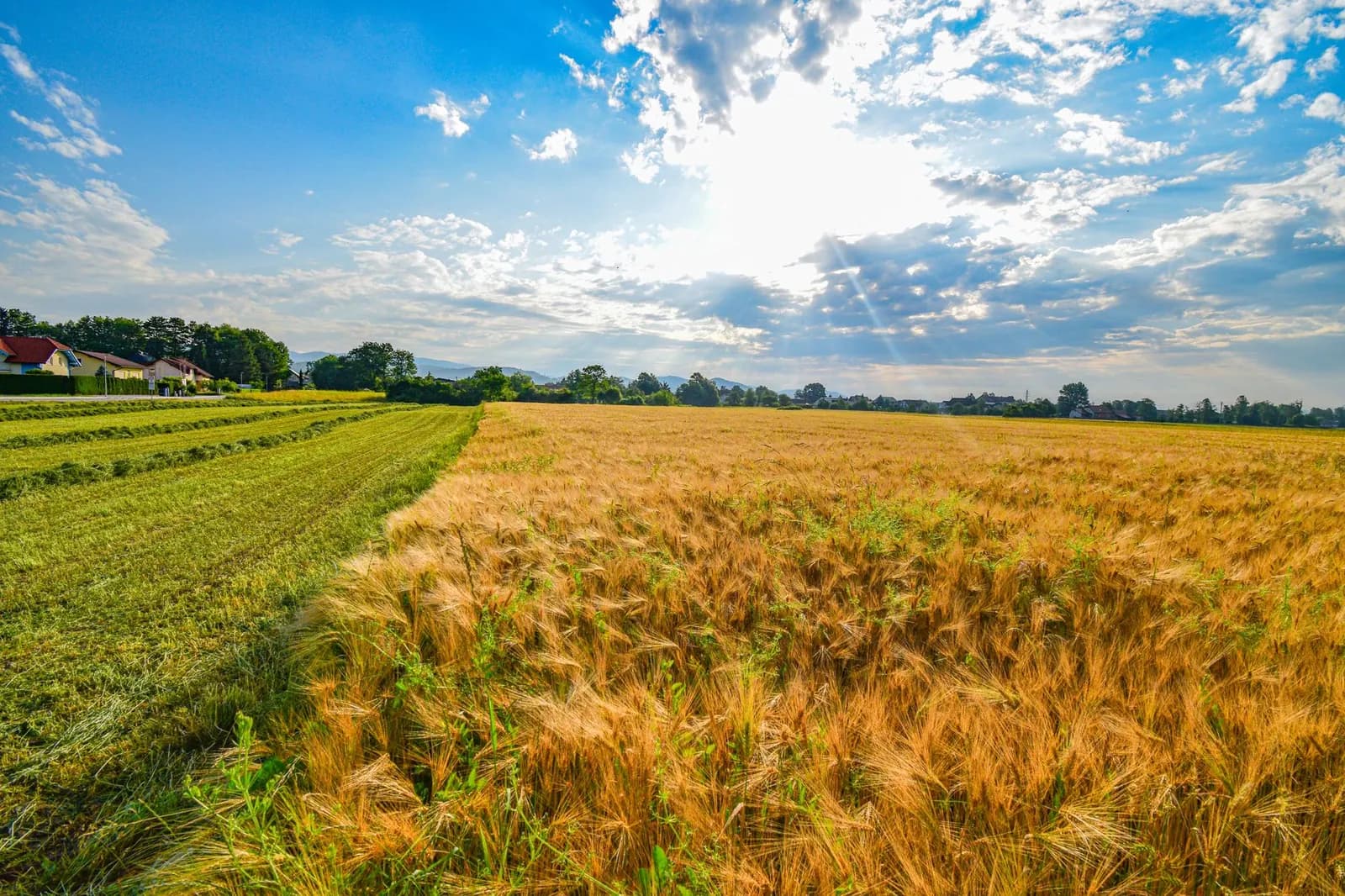
Urea top-dressing of wheat by drone
The best time to apply urea is the first half of February, and 20 February at the latest. The reason is simple: urea takes 20 to 30 days to turn into a form of nitrogen wheat can take up, so a later application cuts yield directly (PSS Zrenjanin, Agrosava). After 20 February, agricultural advisory services usually recommend switching to CAN or AN, where half the nitrogen is available to the wheat straight away. We spread both by drone.
This critical window often falls when the ground is soaked from snow and rain, and heavy spreaders leave deep ruts in the mud. Because the drone flies above the field, mud does not push top-dressing back into March.
For spreading we use the DJI Agras T70P fitted with a separate system that replaces the sprayer: a 100-litre hopper carries up to 70 kg of fertiliser per flight, for granules of 0.5 to 10 mm. The spreading width is 3 to 10 metres, depending on the fertiliser, disc speed and flight height (manufacturer's data). At 100 kg of urea per hectare, one flight covers 0.7 ha, so spreading takes more short flights than spraying.
You set the exact rate (kg/ha) with your agronomist, ideally from a soil test for mineral nitrogen (the Nmin method). Measurements by PSS Zrenjanin show large differences between fields (from 23 to 235 kg N/ha), so working without a test is guesswork. Our drone spreads exactly the amount you set.
Urea spreading by drone costs €40 per hectare, whatever the area. Just tell us how many kilograms per hectare you plan to apply. More on timing and splitting nitrogen: Urea top-dressing of wheat: when and how much.
Second top-dressing and foliar feeding
The corrective (second) top-dressing usually goes on 3 to 4 weeks after the first, and no later than the start of stem elongation. This is a key moment, because yield potential is being set and the nitrogen has to be available to the plant straight away (Agrosava). We spread granular fertiliser for the second top-dressing the same way as urea.
For foliar feeding we apply 15 to 20 litres of water per hectare, at the standard spraying price. Details and timing for the second top-dressing and foliar treatments: Second top-dressing of wheat and foliar feeding.
Fusarium control in wheat at flowering
Fusarium head blight has to be stopped with a fungicide right at the start of flowering (when only about 5% of ears show anthers), and always before forecast rain. Several days of rain at flowering carry a high risk of infection, and on infected grain the fungus produces mycotoxins that are very dangerous to people and livestock (Forecasting and Warning Service, via AgroSmart). This window lasts only a few days, so we time the treatment day carefully with the agronomist, following the weather forecast.
The flowering fungicide is also the most important wheat treatment we do by drone. When it rains in those days, tractor operators are stuck: they have to wait 2 to 5 days for the ground to dry and the window is lost. We only need the access road to dry, and if there is a tarmac approach, we work the same day the rain stops. On grouped fields we cover 20 ha an hour, using 15 to 20 litres of water per hectare.
In dense wheat without tramlines, a tractor permanently destroys 5 to 6% of the crop.
Before flowering, wheat is attacked by leaf diseases (powdery mildew, Septoria, rusts). Fungicide protection starts from stem elongation, either preventively or at the first symptoms (Agrosava). If cereal leaf beetle appears in the crop, we also apply an insecticide to protect the yield (after notifying local beekeepers).
Your agronomist chooses the product and rate from the label, and Nikola mixes it precisely in our tank at the field. More on diseases: Wheat diseases: when to spray against Fusarium head blight.
Weed control in wheat
We apply herbicide to wheat by drone as part of the first spring spray (tillering to the start of stem elongation), often together with a fungicide (Agrosava), on the strict condition that there are no herbicide-sensitive crops right next to the field. If a sensitive crop is across the boundary, we leave the job to the tractor, because its nozzles run closer to the ground and drift less. The tractor is also always the better choice for early herbicides aimed at small weeds just after emergence.
Wheat treatment calendar
These timings are standard practice, but the exact day always depends on the weather and the agronomist's advice.
| Treatment | When | Drone or tractor |
|---|---|---|
| First top-dressing with urea | First half of February, 20 February at the latest | Drone, even when the field is muddy |
| First top-dressing with CAN or AN | After 20 February until early March | Drone, also on wet fields |
| Second top-dressing | 3 to 4 weeks after the first (start of stem elongation) | Drone |
| Early herbicide | Straight after emergence | Tractor |
| Spring herbicide and fungicide | Tillering and start of stem elongation | Drone (if there are no sensitive crops next door), otherwise tractor |
| Leaf fungicide | From stem elongation (powdery mildew, rusts, leaf spot) | Drone |
| Foliar feeding | On the agronomist's advice | Drone |
| Insecticide (cereal leaf beetle) | When it appears and on the forecast | Drone |
| Flowering fungicide (Fusarium) | Start of flowering (5% anthers), always before rain | Drone (can work straight after rain with tarmac access) |
For a side-by-side comparison of drone and tractor output and capabilities, see drone or tractor.
How much wheat top-dressing by drone costs
Every drone spraying treatment on wheat (including foliar feeding) costs €25/ha up to 20 ha, €22/ha from 20 to 100 ha and €20/ha over 100 ha. Urea spreading is a flat €40 per hectare. Travel within 50 km of Opovo is free. You supply the product and the water.
Worked example: 50 ha of wheat near Crepaja (26 km from Opovo), a new client's first order, flowering fungicide. 50 ha × €22 = €1,100, minus €22 for the free first hectare = €1,078 in total. Travel is free. Jobs of 50 ha or more need a 30% advance (€323.40 in this case), and the rest is paid when the job is done.
If you agree a package of three treatments on the same field in a season (for example herbicide and fungicide in spring, foliar feeding and the flowering fungicide), you get 5% off; a package of five or more treatments gets 10% off. You pay after each treatment, and clients with a package get priority when booking. Full prices are in the price list.
What will spraying your field cost?
Pick the service, the crop and the place. You see the price at once, with travel and discounts.
Road distances: © OpenStreetMap contributors
Estimated price
Enter the area and choose the place to see the price here.
Questions about wheat top-dressing and protection
In the first half of February, and 20 February at the very latest. Because urea takes 20 to 30 days to become available to the plant, CAN or AN is recommended after that date. The right rate per hectare comes from a soil test (the Nmin method).
Yes. The drone never touches the ground, so mud in the field does not matter. All we need is clear access to the edge of the field and a few square metres for take-off. We work in winds up to 3 to 5 m/s.
The 100-litre hopper carries up to 70 kg. Depending on granule size and flight height, the spreading width is 3 to 10 metres. At 100 kg/ha one flight covers about 0.7 hectares.
Only at the start of flowering, when about 5% of ears show anthers, and ideally just before forecast rain. If it does rain, tractors cannot go into the mud, but we spray by drone as soon as the rain stops, provided there is a hard road to the field.
Foliar feeding on 50 ha is 50 × €22 = €1,100 (minus the free first hectare, €1,078 in total). If we spread urea, it is 50 × €40 = €2,000. Because of the size of the job, a 30% advance is paid.
Your agronomist always chooses the product and rate and makes sure the pre-harvest interval (PHI) is respected, working from the product label. Our job is to mix that product correctly at the field and apply it precisely.
- First hectare free
- Free travel within 50 km
Book top-dressing before February
The urea deadline is 20 February and the window for the flowering fungicide is very short, so get in touch before the season starts and we will reserve a date for your field in time.