

Sunflower protection by drone
Drone spraying is the right tool for sunflower once the rows close and a tractor can no longer get through without breaking stems. We apply fungicide from bud stage to the end of flowering and carry out pre-harvest desiccation, with no trampling at all. The price is €20 to €25 per hectare, and new clients get the first hectare free on a first order of at least 10 ha.
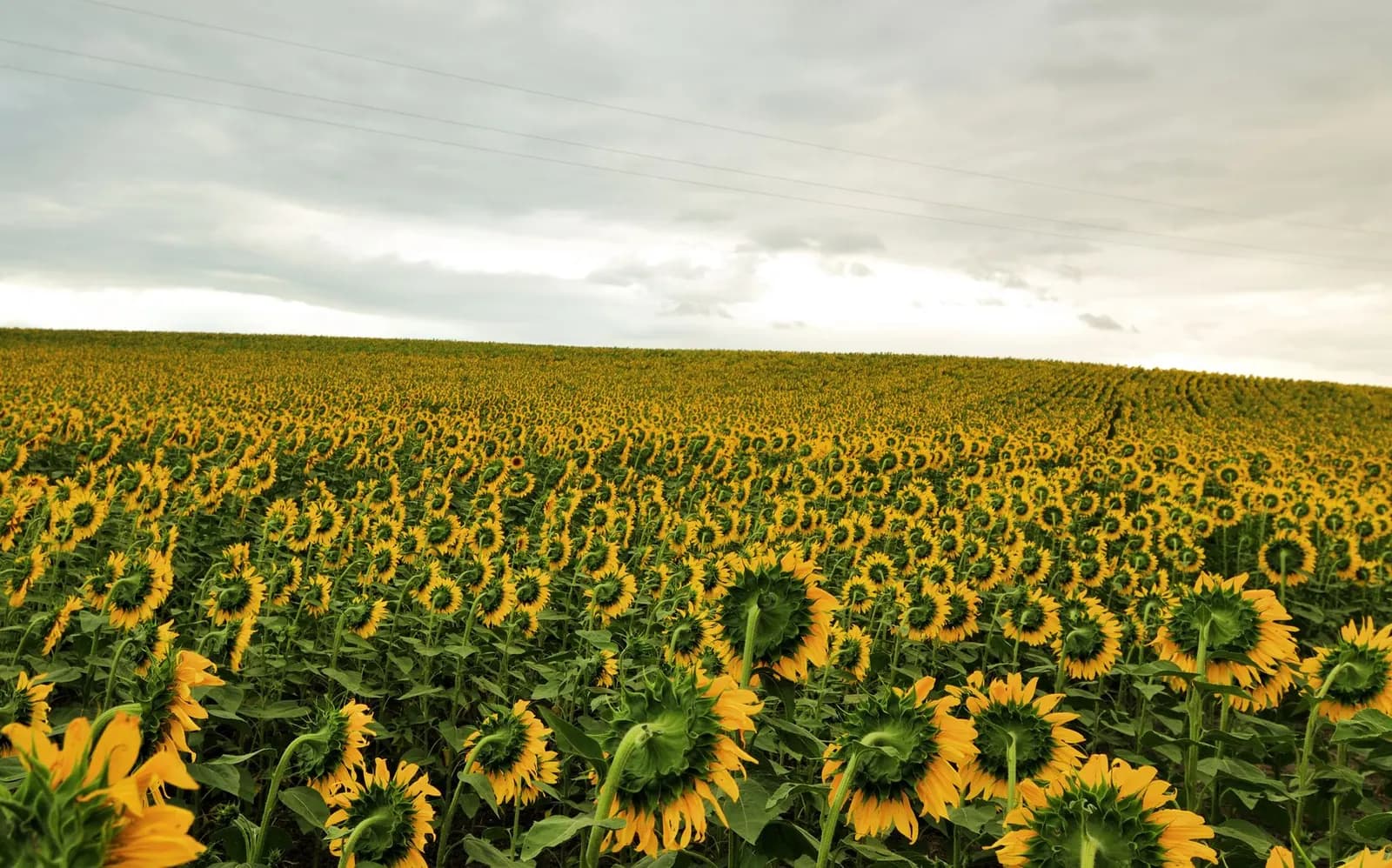
Why a drone once the rows close
Once sunflower is taller than 1 to 1.5 m, a tractor sprayer breaks stems and permanently flattens about 5 to 6% of the crop in its wheel tracks. The drone avoids this: it flies 3 m above the heads, and the strong downdraught from the rotors drives the droplets down to the lower leaves, so the product covers the whole canopy.
The drone needs only 15 to 20 litres of water per hectare, against 150 to 400 litres for a tractor. On grouped fields we can do about 20 ha an hour, roughly twice a tractor's daily output. It can also work after rain: only the road to the field needs to dry, and if you have tarmac access, we work the same day.
For comparison, contract tractor spraying costs about RSD 2,000 per cadastral jutro (around €30 per hectare), and that price does not count the yield lost to trampling. Our drone price is €20 to €25. The full calculation is on the drone or tractor page.
Sunflower diseases: spraying at flowering
The diseases that cost sunflower the most yield are Phomopsis stem canker, Sclerotinia white rot and grey mould. The best window for fungicide is from bud stage (when the bud appears at the top of the stem) to the end of flowering. For Phomopsis the crop is most susceptible during and just after flowering, and advisory services (such as PSS Sombor) recommend controlling grey mould in the same window.
We set the exact spray day by combining PIS warnings (the Plant Protection Forecasting and Warning Service) with the state of your field. You choose the product and rate with your agronomist, and Nikola then mixes it precisely in our tank at the field.
Trial results support the drone at this stage. In a 2024 field trial (Șerban et al.), two fungicide treatments by drone at only 10 litres of water per hectare reached 94% efficacy, while one treatment at 200 litres per hectare, the volume a tractor sprayer uses, gave only 58%.
Sunflower desiccation: when and how
Desiccation of sunflower (drying the crop chemically) gives even ripening and an earlier harvest. It is done once the seed reaches physiological maturity, usually 25 to 40 days after flowering. Your agronomist sets the exact moment from the seed moisture for your hybrid.
Sunflower carries a lot of green material (leaves, stem and head often stay green after the seed is ripe), so harvesting without desiccation causes real problems: the combine's sieves clog, wet debris gets into the seed, and the crop arrives at the buyer with high moisture and extra drying costs.
The right seed moisture for desiccation is 25 to 45%, and hybrids can differ by up to 10 percentage points. Timing matters: desiccating too early cuts yield and thousand-seed weight, while desiccating too late no longer shortens the wait for harvest. Done correctly at temperatures above 20 °C, harvest can start 7 to 14 days earlier. Cooler weather or rain slows the drying down (Đukić et al., 2007).
When desiccation is done by tractor, the sprayer booms break plants in two rows: by the same study's calculation, 7% of plants are flattened and the actual yield loss is about 3.5%. By drone, that loss disappears. To protect neighbouring crops from drift, we work in winds of up to 3 to 5 m/s.
Full details of the service: desiccation by drone. More on timing and method: sunflower desiccation: when and how it is done.
Pre- and post-emergence spraying of sunflower
Pre-emergence spraying (soil-applied herbicides after sowing, before the crop emerges) is still a job for the tractor. The sprayer can run very low and soak the soil and weed seeds with a large volume of water. In conventional sunflower hybrids it is also the only line of defence against broadleaf weeds. After emergence, all hybrids can be treated against Johnson grass and other grass weeds, but broadleaf weeds can be controlled with herbicides only in tolerant IMI and SU hybrids, by the third leaf pair at the latest (following the manufacturers' recommendations, such as Galenika Fitofarmacija or ADAMA).
We apply these herbicides by drone only when long spells of rain keep the tractor off the field, and only if the nearby fields carry the same crop.
More on weed types and herbicides: pre- and post-emergence spraying of sunflower.
Sunflower treatment calendar
These stages are standard practice, but the exact day is always set by PIS warnings and your agronomist.
| Treatment | When | Drone or tractor |
|---|---|---|
| Pre-emergence herbicide | After sowing, before emergence (April) | Tractor |
| Post-emergence herbicide | Up to the 3rd leaf pair (May); broadleaf weeds only in IMI and SU hybrids | Tractor; drone only when mud keeps the tractor out and the neighbouring crop allows it |
| Foliar feeding | On the agronomist's advice | Drone (tractor possible before the rows close) |
| Fungicide | From bud stage to the end of flowering | Drone |
| Desiccation | Physiological maturity, by seed moisture (August and September) | Drone |
How much sunflower desiccation by drone costs
Sunflower desiccation costs €25 per hectare up to 20 ha, €22 from 20 to 100 ha and €20 over 100 ha. The same prices apply to fungicide treatments and foliar feeding. You supply the product and the water. Travel within 50 km of Opovo is free; beyond that we charge €1 for every extra kilometre (one way, per visit).
Worked example (a new client's first order): 35 ha of sunflower near Alibunar, 61 km from Opovo.
- 35 ha × €22 = €770
- First hectare free: −€22
- Travel: €11 (11 km over 50 km × €1)
- Total to pay: €759
If we do three treatments on the same field in a season (for example foliar feeding, fungicide and desiccation), you get 5% off; a package of five or more treatments gets 10% off. Clients with a package get priority when booking, and you pay after each treatment. We take fields under 10 ha only within 20 km of Opovo. More details in the price list.
What will spraying your field cost?
Pick the service, the crop and the place. You see the price at once, with travel and discounts.
Road distances: © OpenStreetMap contributors
Estimated price
Enter the area and choose the place to see the price here.
Questions about sunflower protection by drone
When the seed reaches physiological maturity and stops filling, usually 25 to 40 days after flowering, during August and September. The most reliable sign is the seed moisture percentage. The maturity threshold varies between hybrids, so we leave the decision to the agronomist, based on measurements from the field.
Yes. That is the main fungicide window (from bud stage to the end of flowering), precisely because a tractor cannot get into the field then. Whether a product is safe to apply at flowering is stated on the label. Before using an insecticide we always notify local beekeepers so they can close their hives in time.
As with other field crops, we use 15 to 20 litres of water per hectare (a tractor uses 150 to 400 litres). You supply the water: we fill our trailer-mounted tank together before take-off, and for large areas you need to provide a bowser or IBC containers.
That depends only on the product's pre-harvest interval (PHI, given on the label) and the agronomist's advice. The drying rate depends on the weather: above 20 °C, harvest starts 7 to 14 days earlier than with natural drying. Cooler weather and rain slow the process down.
Yes, but only by drone. In a 2024 trial, the second fungicide treatment was applied by drone on 7 August, after flowering: two drone treatments gave 94% efficacy, and one treatment at 200 litres of water per hectare gave 58% (Drones, 2026).
The base price for 35 ha is €22 per hectare, which comes to €770. If you are a new client, the first hectare is free, which brings it down to €748. If the field is within 50 km of Opovo, that is the final price. For more distant locations (for example Alibunar, 61 km away) travel is added at €1 for every extra kilometre, €759 in total.
- First hectare free
- Free travel within 50 km
Book sunflower protection by drone
Tell us the location, the number of hectares and the type of treatment. We fix the price from the calculator and agree the exact day by matching the PIS warnings with the current wind forecast.