

Spider mite in soybean: identification and control
Spider mite appears in soybean when it is hot and dry, at 25 to 30 °C, and attacks usually start at the field edge. You recognise it by fine greyish speckling on the upper side of the leaf and fine webbing on the underside of the leaf. Scouting should start as soon as the weather warms up, because hotspots found in time can be treated on their own.
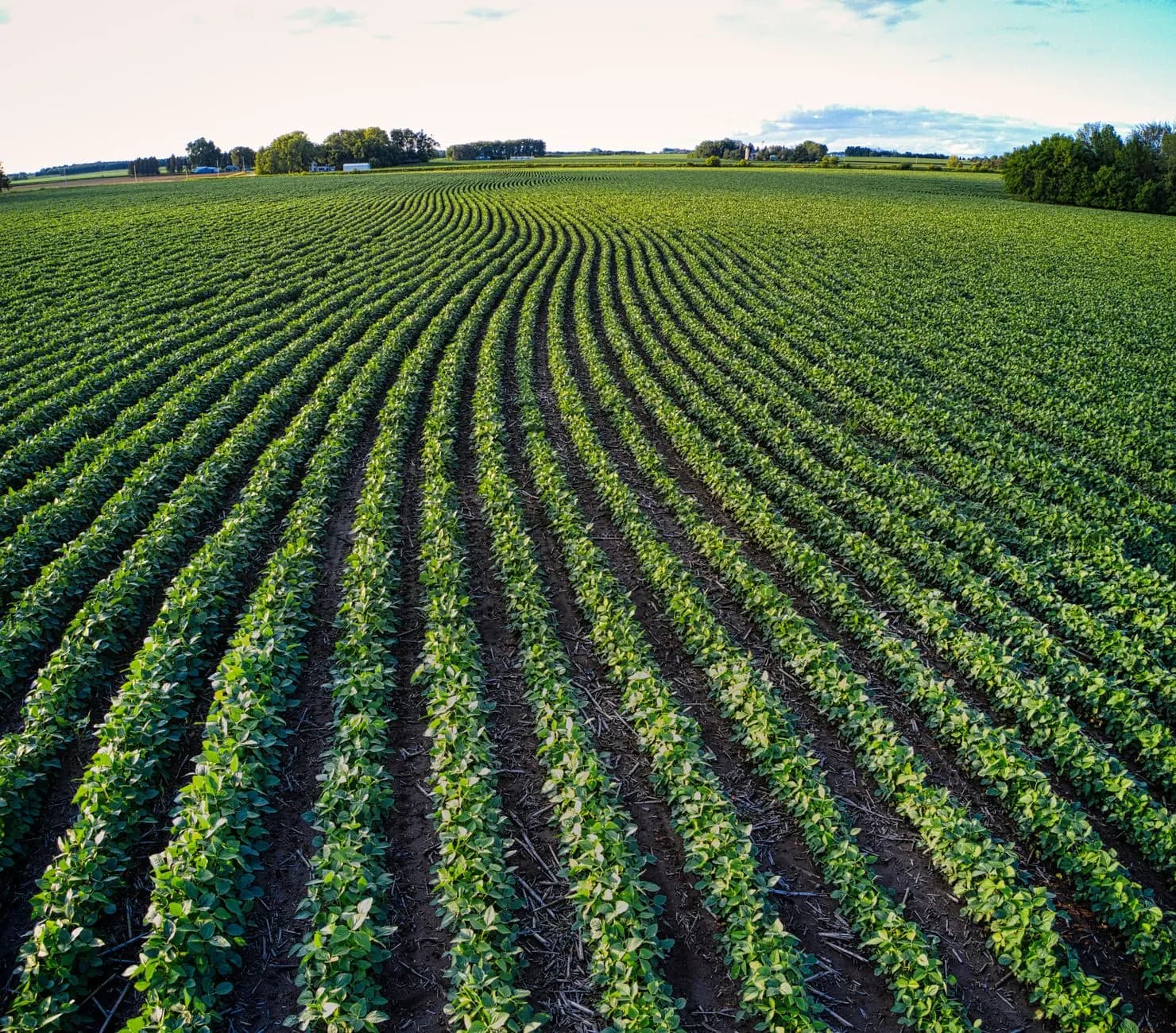
By Nikola Mojsa, MSc in Agricultural Engineering
What a spider mite attack in soybean looks like
Two species occur in soybean: the two-spotted spider mite (Tetranychus urticae) and the strawberry spider mite (Tetranychus atlanticus). Both are yellowish and barely visible to the naked eye, so you notice the damage on the leaf before you see the mite itself (Radmila Ćalić, PSSS, Poljosfera, 2023).
The upper side of the leaf shows fine greyish speckling. As the attack builds, the leaf turns yellow, then red, dries and drops, and fine webbing is clearly visible on the underside. The mite sucks sap from the underside of the leaf, so turn the leaf over and look for webbing.
| Where to look | What you see |
|---|---|
| Upper side of the leaf | Fine greyish speckling |
| Underside of the leaf | Fine webbing in heavier attacks; yellowish mites, barely visible to the naked eye |
| Whole leaf, heavy attack | Yellowing, reddening, drying and leaf drop |
| Field | Attacks start along the field edge or on the headlands; they can also appear in the middle, as isolated patches |
Source (in Serbian): Radmila Ćalić, PSSS, Poljosfera, 2023.
Why spider mite appears in hot, dry weather
Mites thrive in high temperatures and drought, at 25 to 30 °C (PSSS, Poljosfera). That means summer, but the exact timing varies from year to year, so scouting is not tied to a calendar date.
Start scouting at the field edge and on the headlands, then work towards the middle, because mites can also appear inside the field, in isolated patches.
When to treat soybean for spider mite
The advisory recommendation is to treat as soon as the first hotspots are found, and only those spots, in the evening, once the heat of the day has passed, with a repeat treatment after 10 days (PSSS, Poljosfera). The source gives no threshold for the number of mites per leaf, so the decision rests on scouting your field and on your agronomist.
The conditions for drone work are the same as for a tractor sprayer: no spraying in the worst of the heat, because the treatment won't work. Your agronomist chooses the product and rate according to the label, and Nikola mixes it at the field. Before an insecticide treatment we notify nearby beekeepers so they can close their hives.
How the drone covers the underside of the leaf
Spider mites live on the underside of the leaf, the hardest place for the product to reach. That is why at least 800 litres of water per hectare is recommended for a tractor sprayer (PSSS, Poljosfera). The drone does the same job with 15 to 20 litres per hectare.
The drone flies about 3 m above the crop, and the strong downdraught from the rotors drives the fine droplets down to the lower leaves. As a result, the product reaches every part of the plant, including the underside of the leaf.
You can easily check coverage yourself: after the treatment, look at the underside of the leaves where you found webbing before.
What drone spraying for spider mite in soybean costs
Spraying soybean costs €25 per hectare up to 20 ha, €22 from 20 to 100 ha and €20 over 100 ha. You supply the product and the water. We don't charge for travel within 50 km of Opovo.
The spider mite treatment, the repeat treatment 10 days later and desiccation make three treatments on the same field, and we give 5% off for three treatments, 10% for five or more. For 25 ha near Debeljača (16 km from Opovo), all three treatments cost €1,546.60, with the first hectare free on a first order; the bill follows the rules in the price list. Check the price for your location in the calculator.
Frequently asked questions
Fine greyish speckling on the upper side of the leaf and, in heavier attacks, fine webbing on the underside. The mites themselves are yellowish and barely visible to the naked eye. Attacks usually start along the field edge or on the headlands.
When scouting finds the first hotspots, in hot, dry weather, in the evening once the heat has passed. The treatment is repeated after 10 days, as PSSS recommends. Your agronomist sets the threshold and chooses the product.
Yes. The drone flies about 3 m above the crop, and the downdraught from the rotors drives the fine droplets down to the lower leaves, where the mites live. The drone doesn't trample the crop, and after rain it only needs a dry access road to the field.
- First hectare free
- Free travel up to 50 km
Get in touch as soon as you find a hotspot
Tell us the location, the number of hectares and where you found webbing, and we will agree the treatment day around the wind and temperature.