

Foliar feeding: what it is, when it helps and how it is done by drone
Foliar feeding means spraying a nutrient solution onto the leaf instead of spreading fertiliser on the soil. It is a supplement to base fertilisation, not a replacement: it helps under stress and at critical growth stages, and when the plant is short of a micronutrient. Through the leaf, the plant can take up nitrogen, phosphorus and potassium only in small amounts (Agroklub).
By Nikola Mojsa, MSc in Agricultural Engineering
What foliar feeding is and how the plant takes it up
The leaf has a cuticle, stomata and tiny pores that let nutrient ions through (AgriNova). A micronutrient applied to the leaf shows its effect within a few hours to a few days; from the soil, the same effect takes weeks.
Fertiliser spread on the soil depends on moisture: without it, the roots cannot take up nutrients even from well-supplied soil (Agroklub). The leaf gets round that problem, but it has limits of its own: above 24 °C the stomata of some species close and uptake falls (Agroklub). That is why foliar feeding is done early in the morning or towards evening.
When foliar feeding makes sense, and when it doesn't
Foliar feeding makes sense when root uptake is poor or when you know exactly which element is missing. It is not the way to supply the main amounts of nitrogen, phosphorus and potassium: those go into the soil.
| Situation | Foliar feeding | What to do instead or alongside |
|---|---|---|
| Cold, drought, weak roots or unfavourable soil pH | Helps, because root uptake is poor | Deal with the cause (water, pH) separately |
| Micronutrient deficiency (zinc, manganese, boron, magnesium, iron) | Helps, quickly and on target | A soil or leaf analysis or an agronomist confirms the symptom |
| After herbicide stress | Helps as a mild supplement | The agronomist chooses the product and rate |
| A stage when the element is critical (boron before flowering) | Helps only if on time: boron after petal fall is too late for fruit set | Plan the timing in advance |
| Main fertilisation with nitrogen, phosphorus and potassium | Does not replace it | Spreading on the soil, for example fertiliser spreading by drone |
| You don't know what is missing | Applied blind, it doesn't help | Soil or leaf analysis, then the agronomist |
Sources (in Serbian): AgriNova, Agroklub.
As for the number of treatments per season, AgriNova gives 1 to 2 targeted applications for cereals, 4 to 8 for fruit trees, and an interval of 10 to 14 days for vegetables during rapid growth (AgriNova). For every crop, the agronomist sets the number and timing of treatments from the symptoms on the plant.
Foliar feeding by crop
Wheat: targeted at tillering and stem elongation (manganese, zinc and small amounts of nitrogen) and before heading (magnesium and micronutrients). Advice from the PSSS Šabac advisory service also names tillering and the flag leaf stage (Agro Info Net). Wheat gets its main nitrogen from the soil: see top dressing wheat with urea. Timings for the second top dressing and for foliar feeding are in Second top dressing of wheat and foliar feeding.
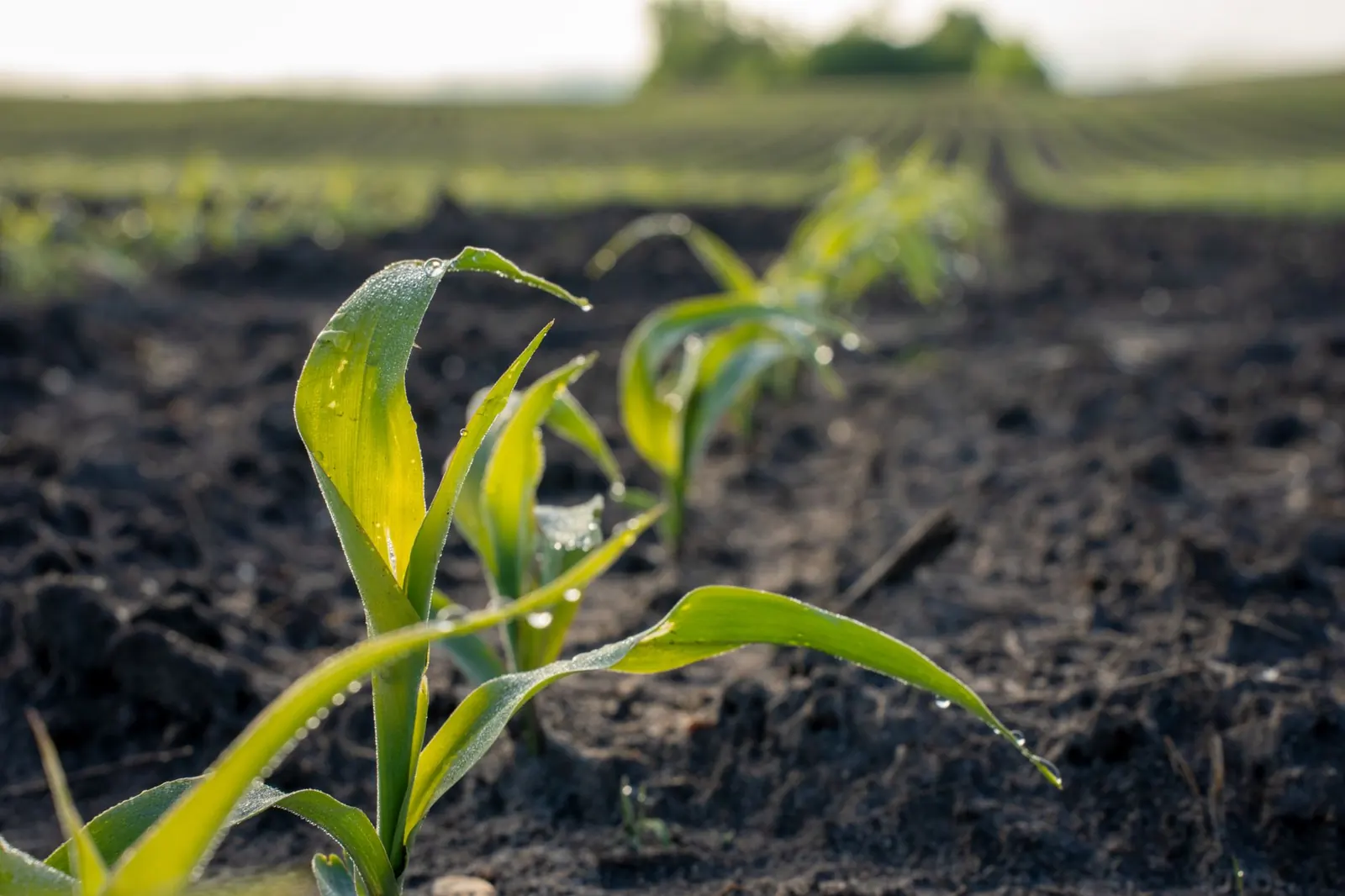
Maize: after stress, or when zinc is short, maize falls behind in growth and pollination is poorer (AgroPortal). We cover the stages and the specifics of feeding tall maize in foliar feeding of maize and on the maize page.
Soybean: boron and molybdenum before flowering and during pod set, following AgriNova's recommendation for legumes; the agronomist confirms the stage and the product (soybean).
Sunflower, oilseed rape, orchards, vineyards and vegetables: stages and nutrients follow your agronomist's advice. The timing table for orchards, vines and vegetables is on the foliar feeding by drone page.
Mistakes that spoil foliar feeding
According to AgriNova and Agroklub, four mistakes are the most common:
- Too high a concentration. A solution stronger than the label allows scorches the leaf. Maize, for example, tolerates only low concentrations (AgroPortal).
- Spraying in sun and heat. Direct sunlight and low air humidity cause leaf scorch and fast evaporation, and Agroklub warns that some formulations are sensitive to light.
- Rain straight after spraying. AgriNova advises postponing the treatment if rain is expected within 2 to 4 hours, depending on the product's formulation.
- A new mix without a test. When two products are mixed for the first time, jar-test the mix first: if it curdles or separates into layers, it must not go into the tank. Apply a new formulation to a small part of the field first and wait 48 hours.
Foliar feeding by drone: water, concentration and tall crops
On field crops the drone sprays 15 to 20 litres of water per hectare, while a tractor sprayer uses 200 to 300 litres (AgriNova). The same amount of nutrient in less water gives a stronger solution, so concentration matters even more with a drone: it is set by the label and your agronomist, who checks that the product can be applied in a low water volume.
Our agronomist Nikola flies about 3 m above the crop, and the downdraught from the rotors drives fine droplets down to the lower leaves, so the solution covers the whole leaf mass. The drone also works once the crop is over 1 to 1.5 m tall, when a tractor breaks 5 to 6% of the crop. After rain, only the access road to the field needs to dry. We don't work in the worst of the heat, because the feed has no effect, and if the wind goes above 3 to 5 m/s we pause and carry on once it drops.
Whether feeding and crop protection can go in the same pass is stated on the product labels; the expert advice is to apply them separately if in doubt (protection today, feeding 48 hours later). Nikola mixes the product himself, at the field.
Price of foliar feeding by drone
Foliar feeding costs the same as spraying: €25 per hectare up to 20 ha, €22 from 20 to 100 ha and €20 above 100 ha. You supply the product and the water. Orchards, vineyards and vegetables carry a €10/ha surcharge. Travel within 50 km of Opovo is free, and new clients ordering at least 10 ha get the first hectare free on their first order.
If we treat the same field three times in a season, for example with a fungicide, an insecticide and a foliar feed, you get 5% off; five or more treatments get 10% off. Check the price for your field in the calculator, and see the offer and terms on the service page.
Frequently asked questions
A nutrient solution sprayed onto the leaf instead of spread on the soil. The leaf takes it up faster than the roots can from dry soil, but nitrogen, phosphorus and potassium arrive this way only in small amounts, so foliar feeding supplements base fertilisation.
Under stress (cold, drought, after a herbicide), when a micronutrient is short, and at stages when an element is critical, such as boron before flowering. Spray at 15 to 25 °C, early in the morning or towards evening. The agronomist sets the exact timing.
No. The plant gets the main amounts of nitrogen, phosphorus and potassium from the soil; through the leaf it gets only a supplement.
€25, €22 or €20 per hectare, depending on the area, plus a €10/ha surcharge for orchards, vineyards and vegetables. New clients ordering at least 10 ha get the first hectare free on their first order.
- First hectare free
- Free travel up to 50 km
Book your feeding before the stage that needs it
Tell us the crop, the area, where the field is and the crop stage at which it needs feeding. We will confirm the price and agree a date before that stage.